FROM CAIRO by Manuel Alvarez Diestro
It’s six o’clock in the morning in Cairo when I call my taxi driver. “Sabah elkheirOmar! (Good Morning, Omar!) Can you come round to pick me up?” “Where do you want to go today, Hadretak?” (Sir) “To New Cairo, as usual,” I reply. “But, whereabouts in New Cairo, it’s enormous…?” he enquires, sounding worried.
“Same as usual, some place where the city ends and the desert begins. Just drop me off with my camera and I’ll find my own way back.”
It’s twenty years since I left left Santander in northern Spain to become a city nomad. Thence came my years in Los Angeles, New York, Boston, San Francisco, Paris, Madrid, Beirut or Algiers. In the various cities where I have lived, I have locked the front doors of different houses so often that occasionally, I wonder where I am! Anyway, I know what to expect right now while I lock this one in Cairo, standing in semi-darkness on a doormat marked Welcome … Omar is waiting for me in the street. It’s just an ordinary Saturday and this charming man from the Shubra district will take me to New Cairo satellite city to photograph the latest residential developments.
We set off in his white Hyundai driving towards Suez. We turn right at Hassan’s quiosk and we already see the River Nile. As we cross the El Mounib Bridge, a forest of billboards lines both pavements. Beneath us, in the middle of the river, we can spot Dahab Island where the last remains of a rural world appear to have been swallowed up by the city. At the end on the right, we can already glimpse the brutalist-style skyscrapers built in the eighties on Maadi’s Corniche. I open the car window and enjoy a breath of fresh breezy air from the Nile and with half-closed eyes, watch the Maadi skyline gradually fade from view.
A few kilometers away, the massive Egyptian backing for horizontal, sprawling suburban development will soon unfold, revealing the great desert conquest.
Being a cityscape photographer specialising in new developments, I could not resist becoming deeply involved in the task of documenting New Cairo. I have called this project, “The Conquest”.
I shall briefly mention the background history of the most important city in the Arab World. From the beginning, El Cairo evolved in close proximity with the River Nile, the connecting thread of its history. For centuries, the Mokattam highlands have witnessed Cairo’s expansion. From a sandy, unpaved lookout, whilst smoking a shisha pipe at one of the makeshift bars complete with sunshades and plastic chairs, you can enjoy a view which, in my opinion, is unique in the world, in the sense that the various epochs of the history of mankind can be summarized through the contemplation of a series of architectural statements.
At a glance and following a visual sequence, on a clear day you can identify the Mastaba of Sakkara tomb, (widely acknowledged as the first architectural structure built 2611 BC), the Giza Pyramid Complex, the minarets of Islamic Cairo and lastly, the skyscrapers in the city centre and in Maadi. Further towards Suez, you can see massive building development works, premonitory of the Cairo of the future. In other words, from Mokattam we are able to witness a procession of vertical structures, representing a huge stride from its origins to the present day. However, the Cairo of the future cannot be envisaged from this balcony view because, owing to lack of space, the city is reinventing itself increasingly further from the Nile.
Returning to my journey in Omar’s new, white taxi, imposed by the authorities to reduce pollution levels (and successfully so), we drive past endless rows of ordinary, bare brick dwellings. Clouds of smoke from improvised fires waft over rooftops covered in pigeon-coops and satellite dishes, evoking a scene borrowed from a futuristic film-set. On the radio the Syrian/Lebanese singer, George Wassouf, is turned on full blast. With electronic percussion music beating to the rhythm of an unending stream of half-constructed buildings passing by, I can contain myself no longer and have to get hold of my camera and take as many shots of this moving periphery as possible.
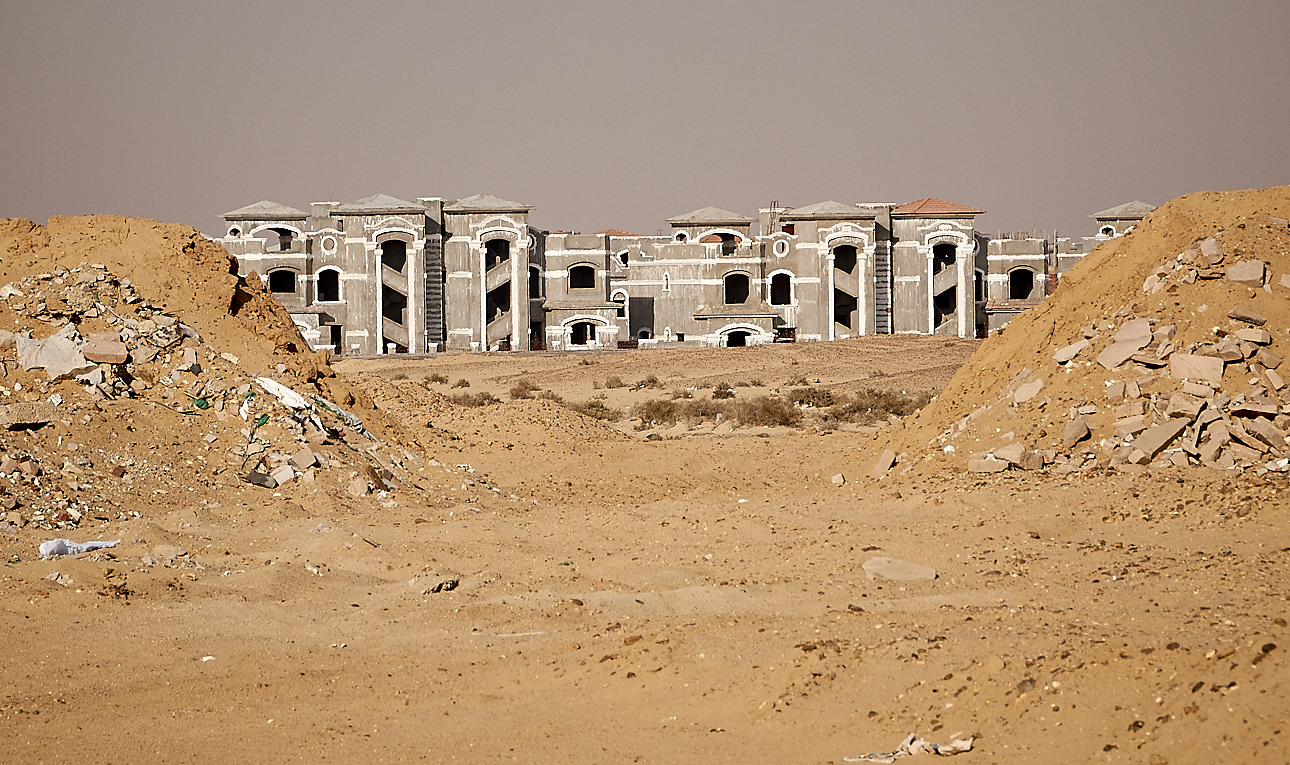
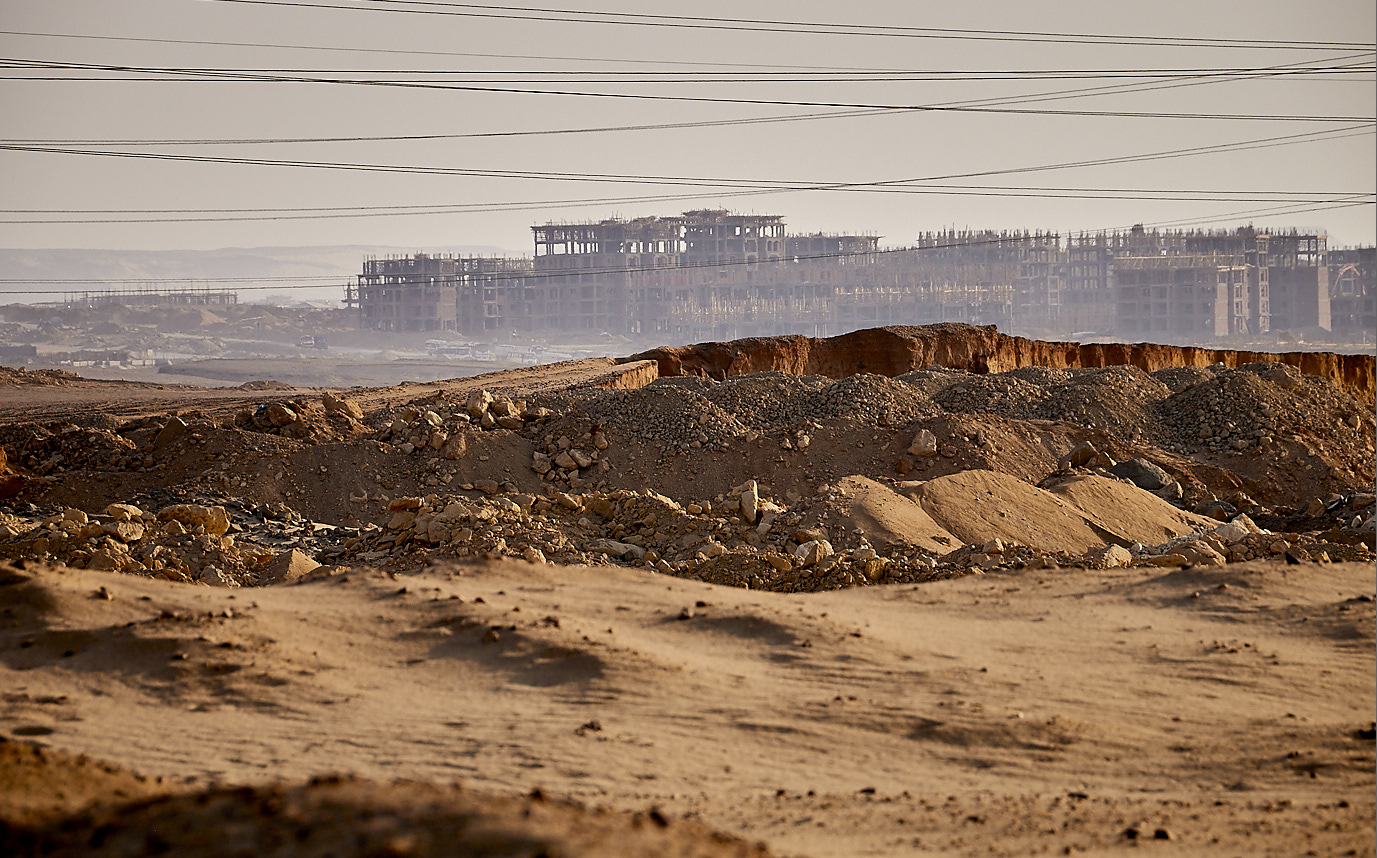
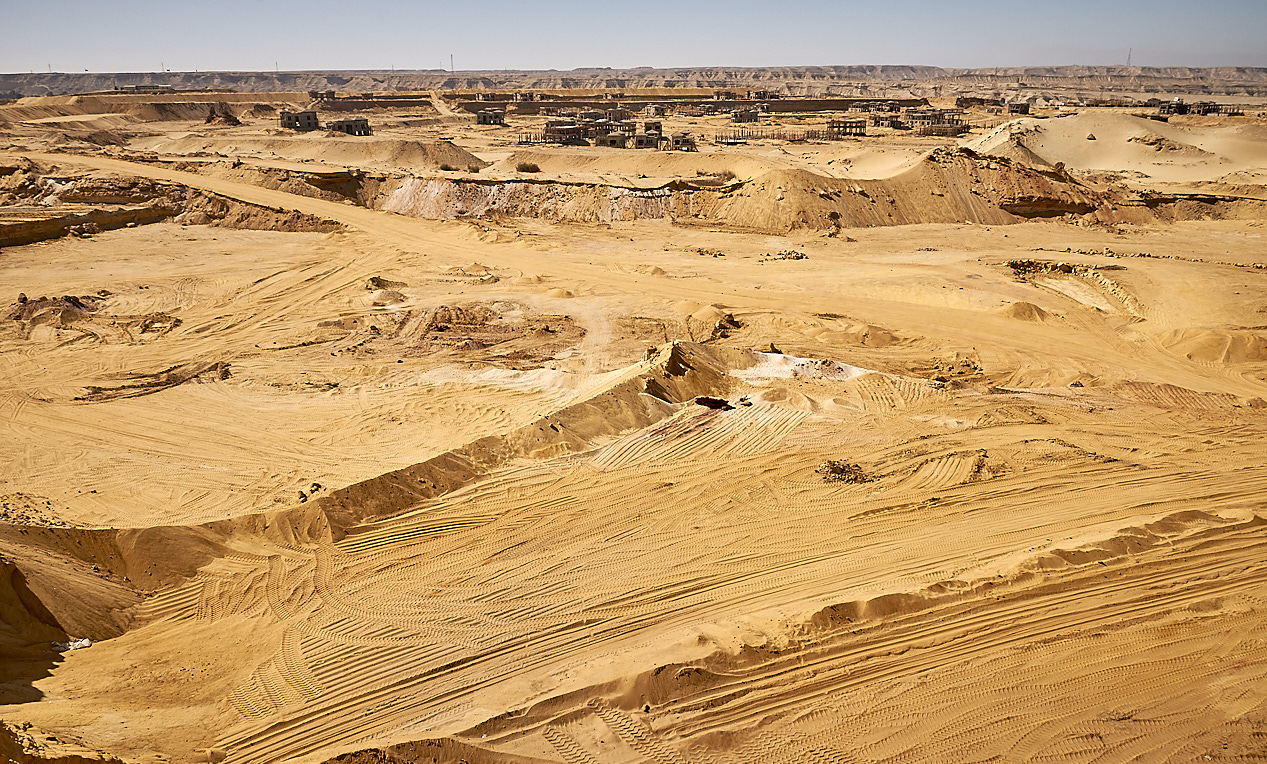
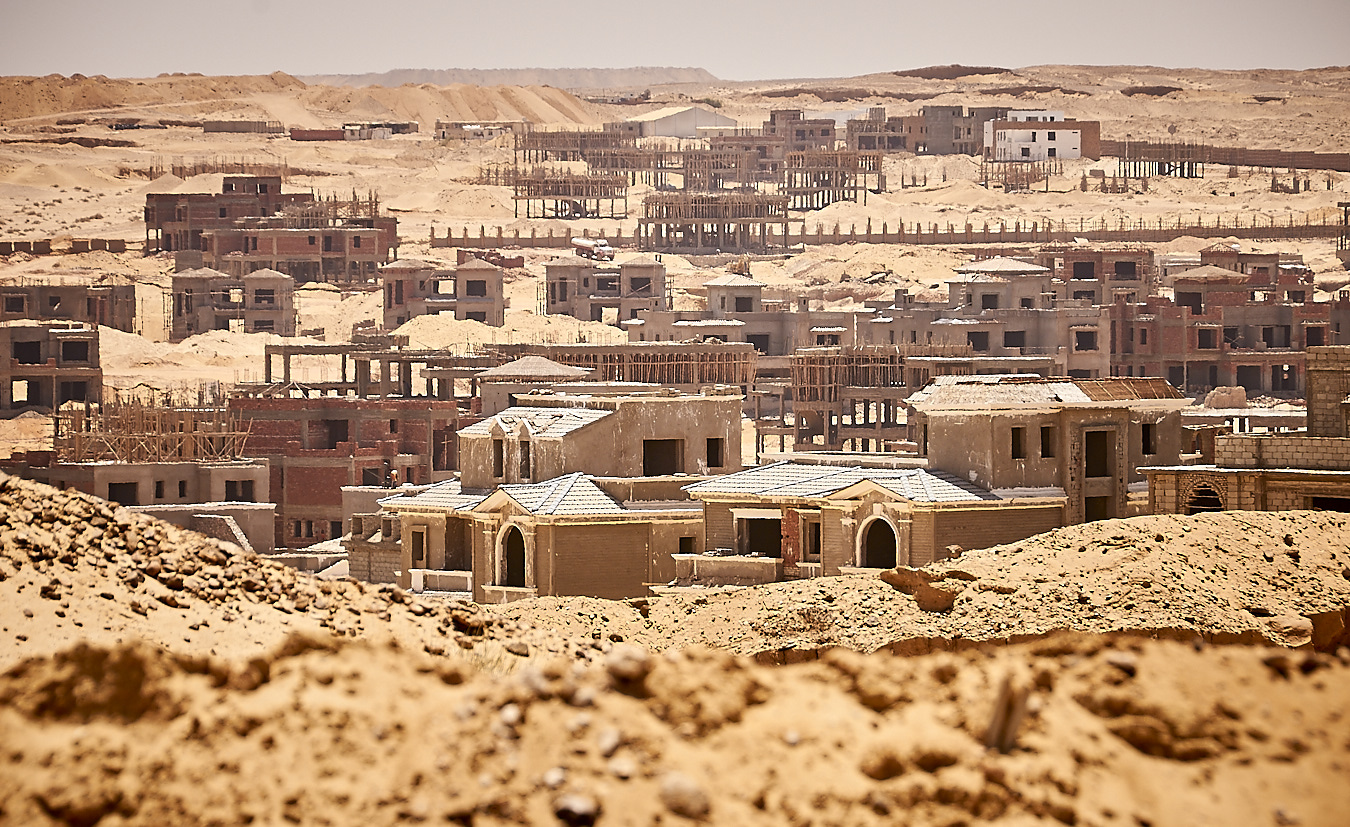
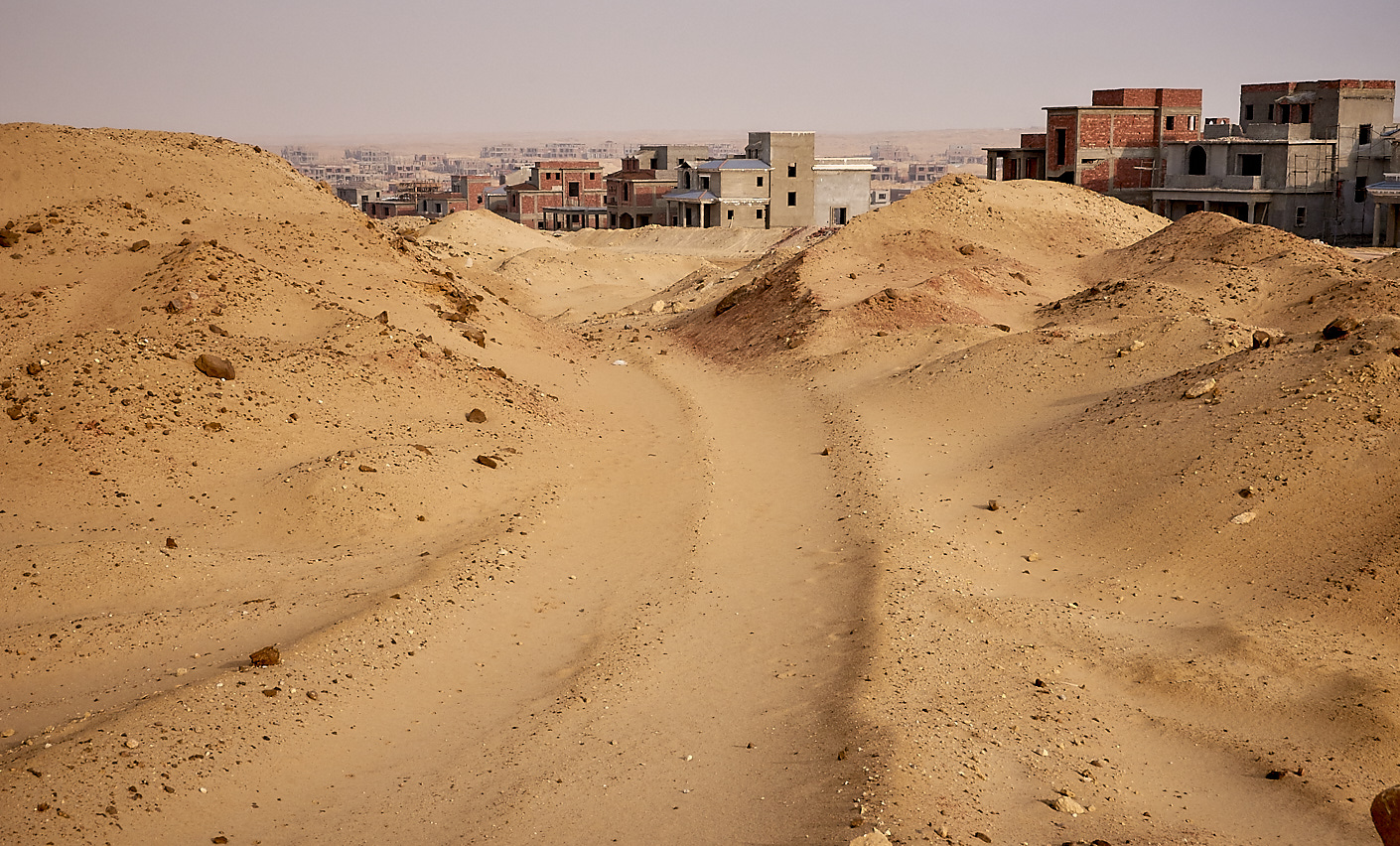
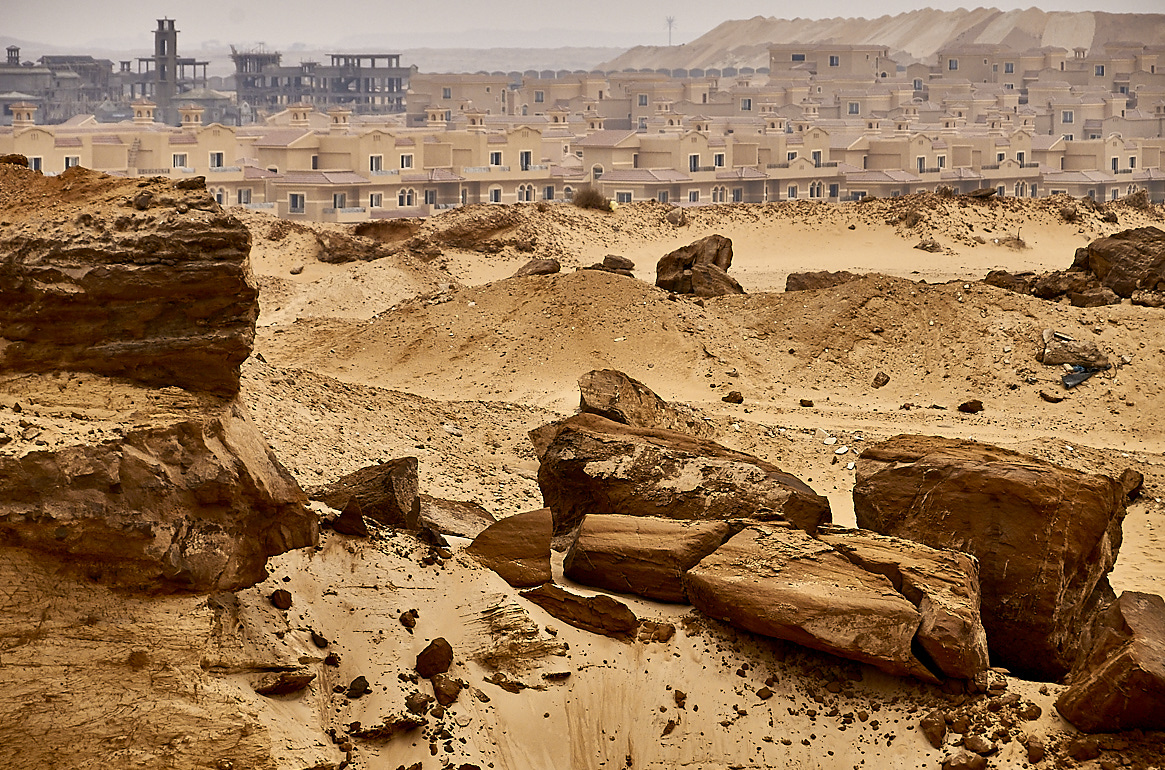
On the right side of the carriageway, just after Carrefour, we observe a giant billboard illustrating Zaha Hadid’s Stone Towers’ project. At the moment, there is only a vast lowland area with a few random structures of future villas, ressembling skeletons stranded on the sand inside an archeological site. A slender, pointed rock stands out alone between the lowland villas. I wonder whether they might transform it into the prime feature of a landscaped roundabout within the projected suburban area. With the Stone Towers and the Convention Centre near the airport, also to be designed by Hadid, Cairo will achieve international status owing to the presence of star architects. Several well-known names, such as Legorreta, Machado and Silvetti, will come here to direct other projects in the Cairo periphery mostly in relation to luxury housing developments as well as public installations. As a consequence, Egypt will feature in contemporary architectural guides which until recently, were reserved for the Alexandria library, built in 2001.
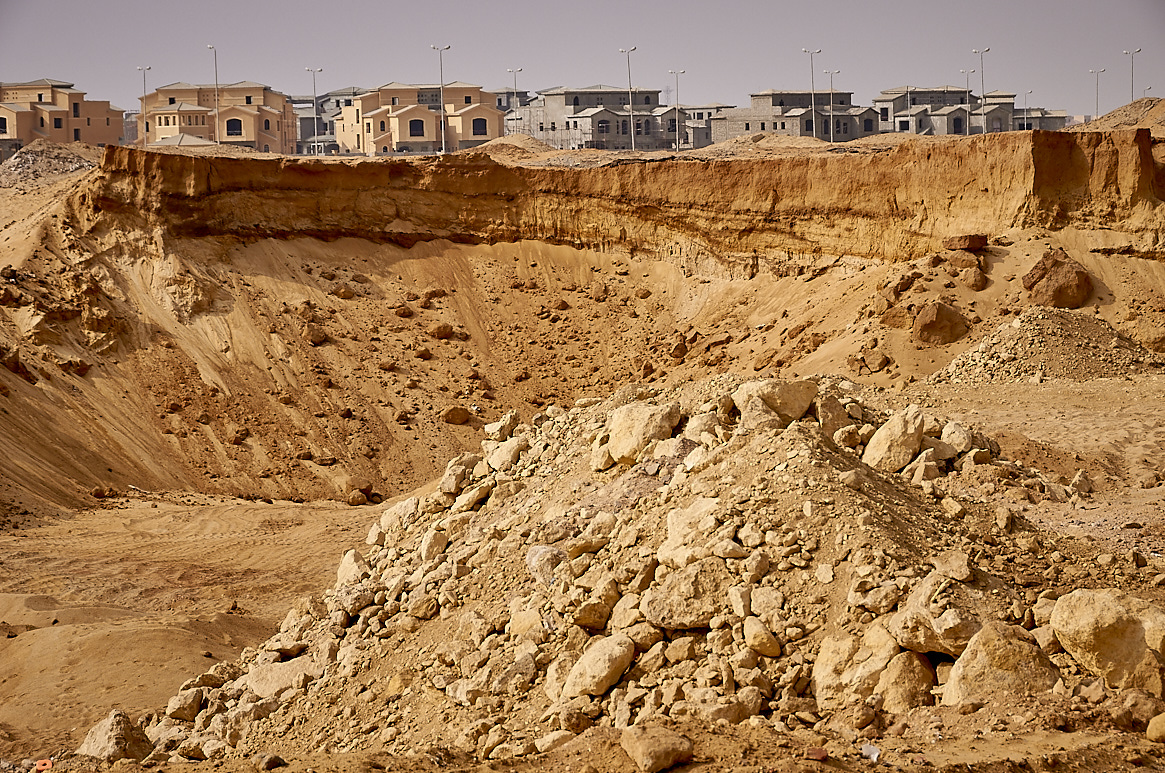
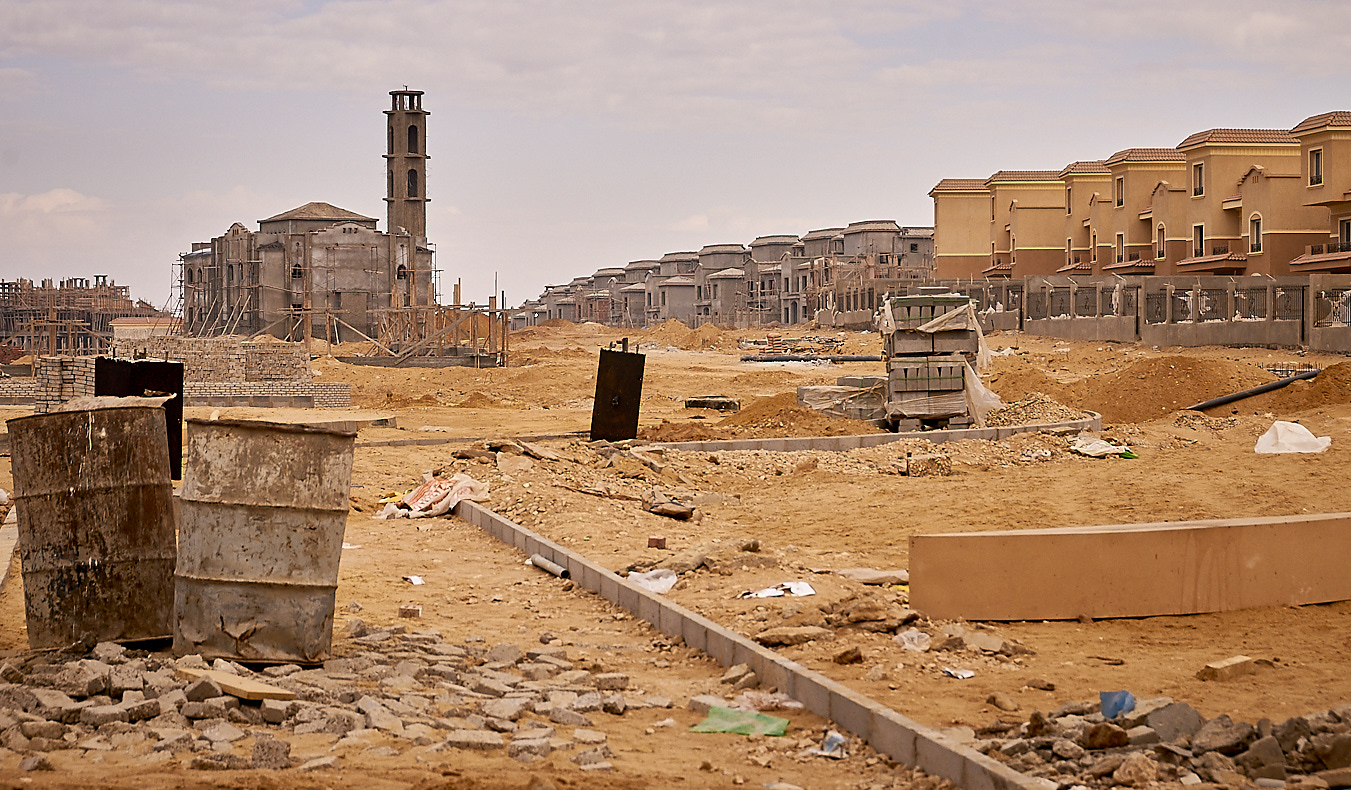
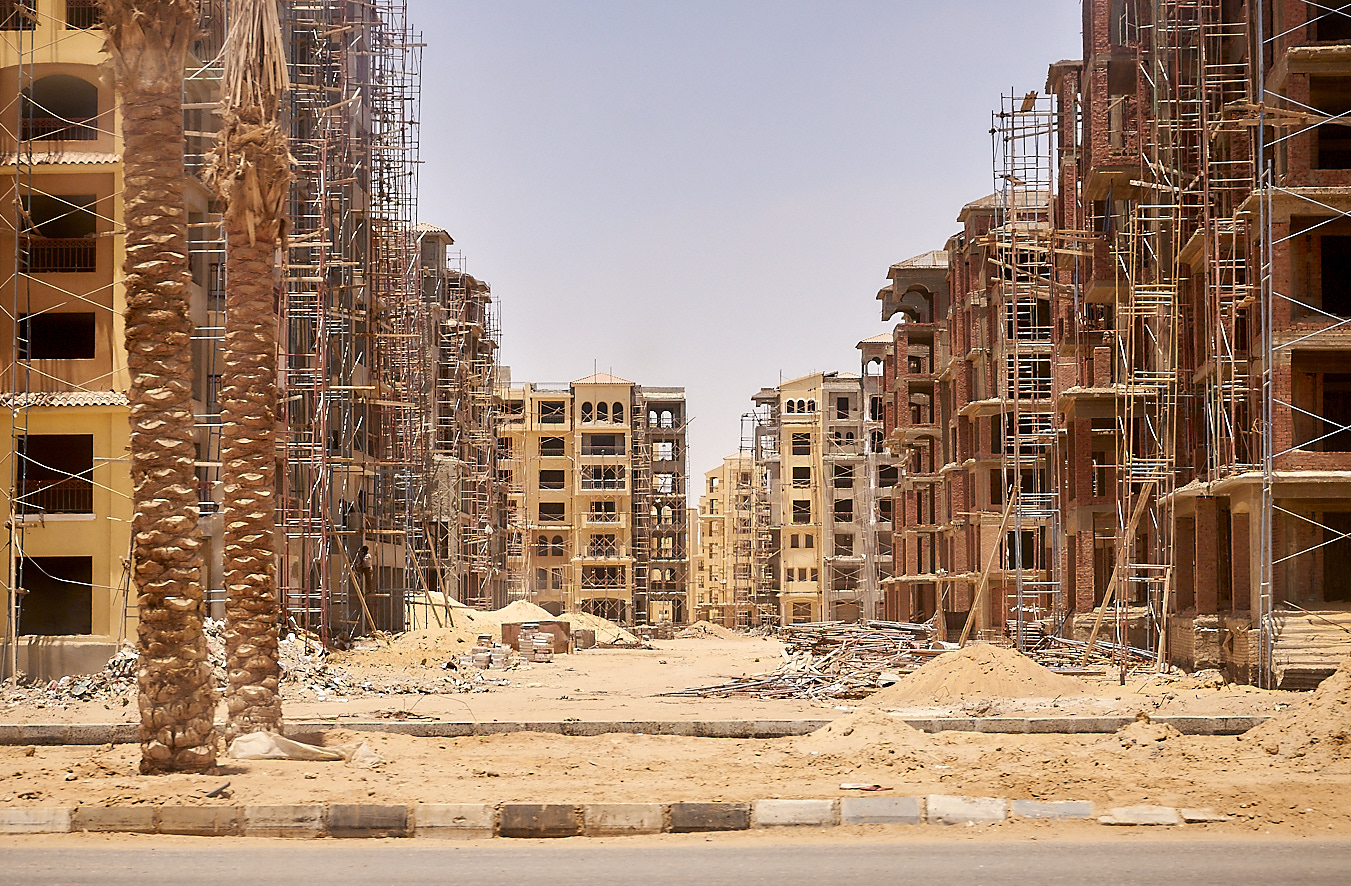
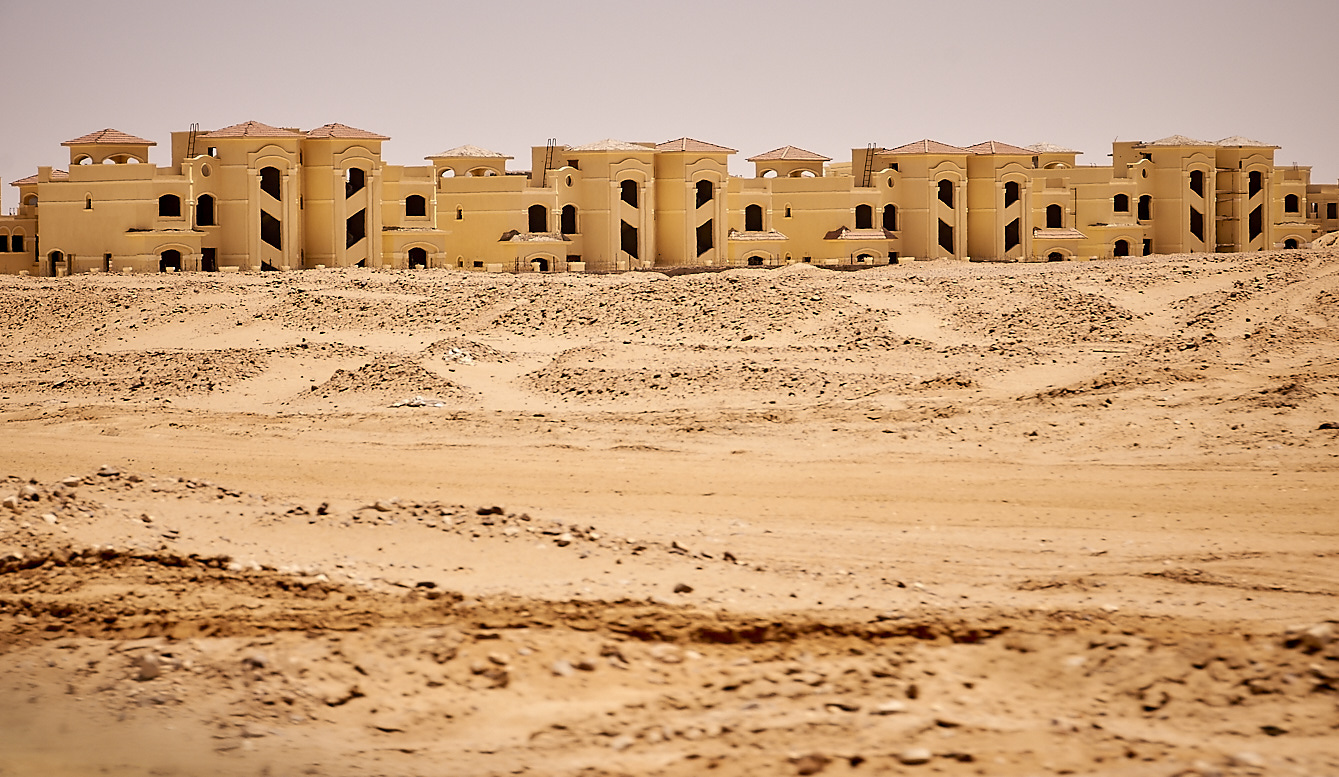
Suddenly, the first gated communities such as the Katameya Heights appear on the scene. There are many types of villas, exhibiting features borrowed from the most diverse and decontextualized architectural styles including the neo-classic, pharaonic, South-American hacienda, not forgetting the Mediterranean, even copying elements from Chinese temples! Only a few kilometres away, we can already notice great construction cranes swaying against the horizon. I tell Omar, “Go that way and turn the sound up, it’s time to celebrate!”
Alongside the multitude of promotional billboards by the road, other conspicuous signposts point to locations such as Future University, the American University (AUC), the German University (GUC) etc. We exit the motorway and arrive in the heart of New Cairo, in the middle of a one-hundred square kilometre area of land, destined to house millions of people in the near future.
Omar and I drive along the great Mubarak Axis Road which crosses the zone designated for commercial activities of the global era, ending where the huge expanse allocated to impending building works, begins.
Many companies, official organisations and public entities will transfer to New Cairo. The city centre needs decongesting in order to make it more livable. Part of the Egyptian middle class and the upper class look for the chance to breathe cleaner air and try to distance themselves from traffic congestion.
Egypt, one of the fastest-developing countries in the world due to rural-urban migration, with a population growth of over one million inhabitants per year, needs drastic urban planning solutions especially in the more marginalised areas. The city centre is at saturation point and the decision to decentralise towards the area behind the Nile appears to be the most appropriate, considering the territory available.
Let us not forget that satellite cities like New Cairo or Sixth of October are not new to El Cairo. Already at the beginning of the 20 th century, part of Cairo’s bourgeoisie moved to Heliopolis in the north and to Maadi in the south of the city.
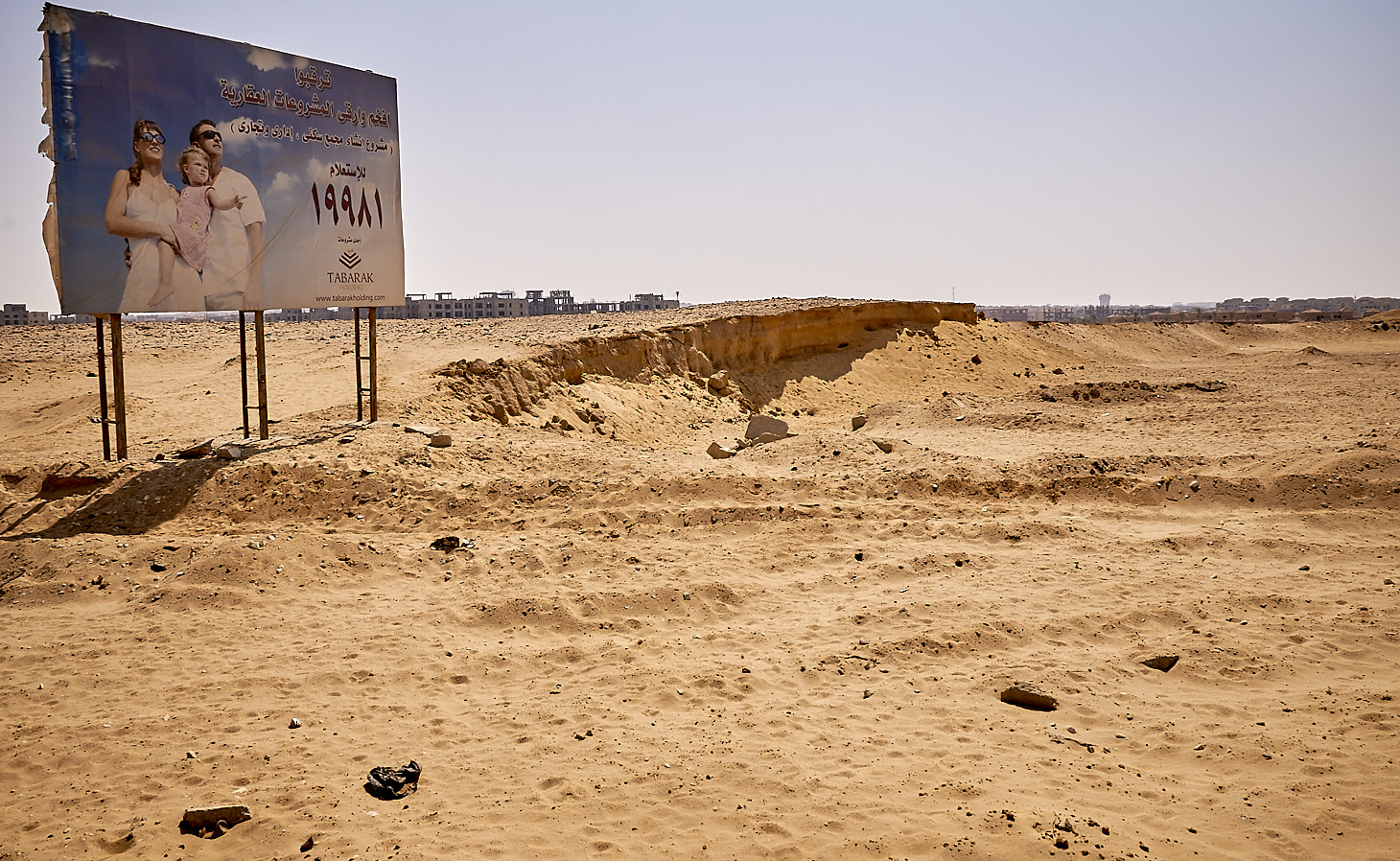
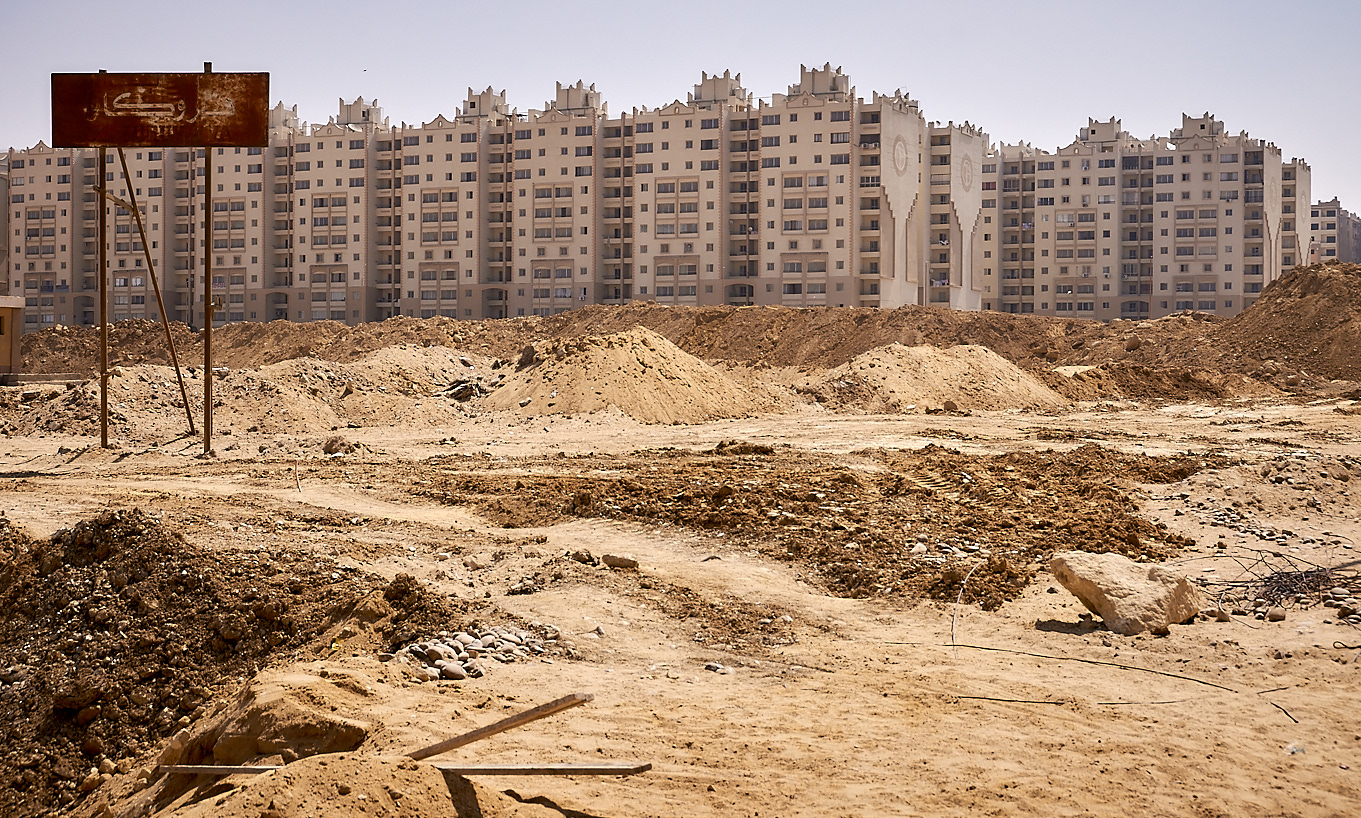
Towards the end of the boulevard, we reach the American University built by the Mexican architect, Legorreta. We arrive at a mosque in the middle of nowhere except for a completely bare, giant billboard reminding me of another one, next to my house in Los Angeles by highway 405. “Omar, would you drop me off at this signpost here – I’ll call you next weekend.” He bids me farewell, saying “Maa Al- Salama, Mr Manuel”. Omar disappears from view along the large, empty boulevard, straddled by hundreds of streetlamps which will soon light up the new city.
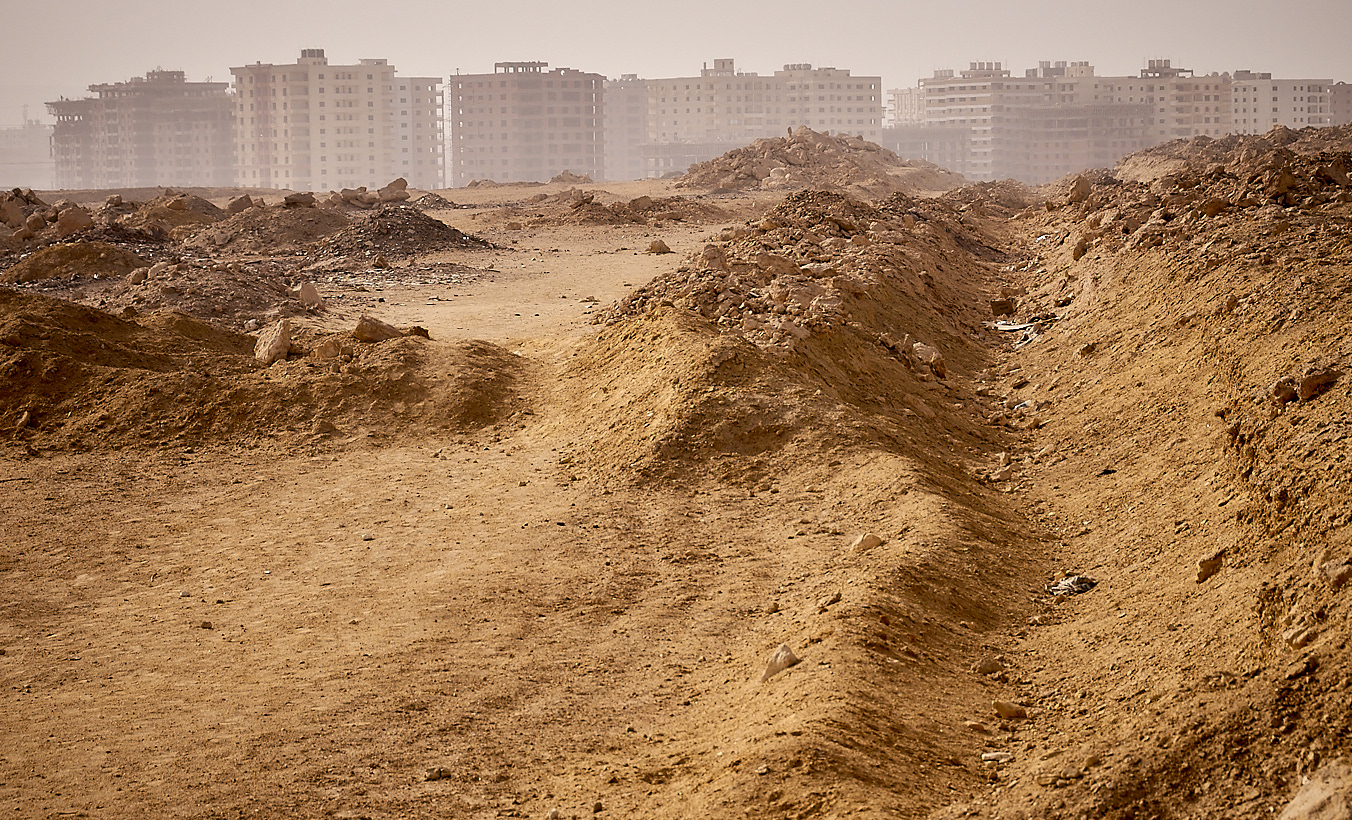
I am standing by a signpost planted in the sand which says, “City Walk!” An arrow points to the desert with the bare outline of a future road traced in the soil. Holding my camera and with sand getting into my sandals, I begin to feel the adrenalin. During the next few hours, under the red-hot sun, I shall enjoy paradisal irresponsibility as the essayist, William Arrowsmith, would have said. In his book, Antonioni: The Poet of Images, he alludes to this term referring to the meanderings of the characters in films made by the Italian director, Michelangelo Antonioni. And just like some of his characters meandering through the outskirts of Rome, I sense that I’m getting lost, without a map or GPS, which has happened to me so many times during the past twenty years whilst searching or the perfect periphery.
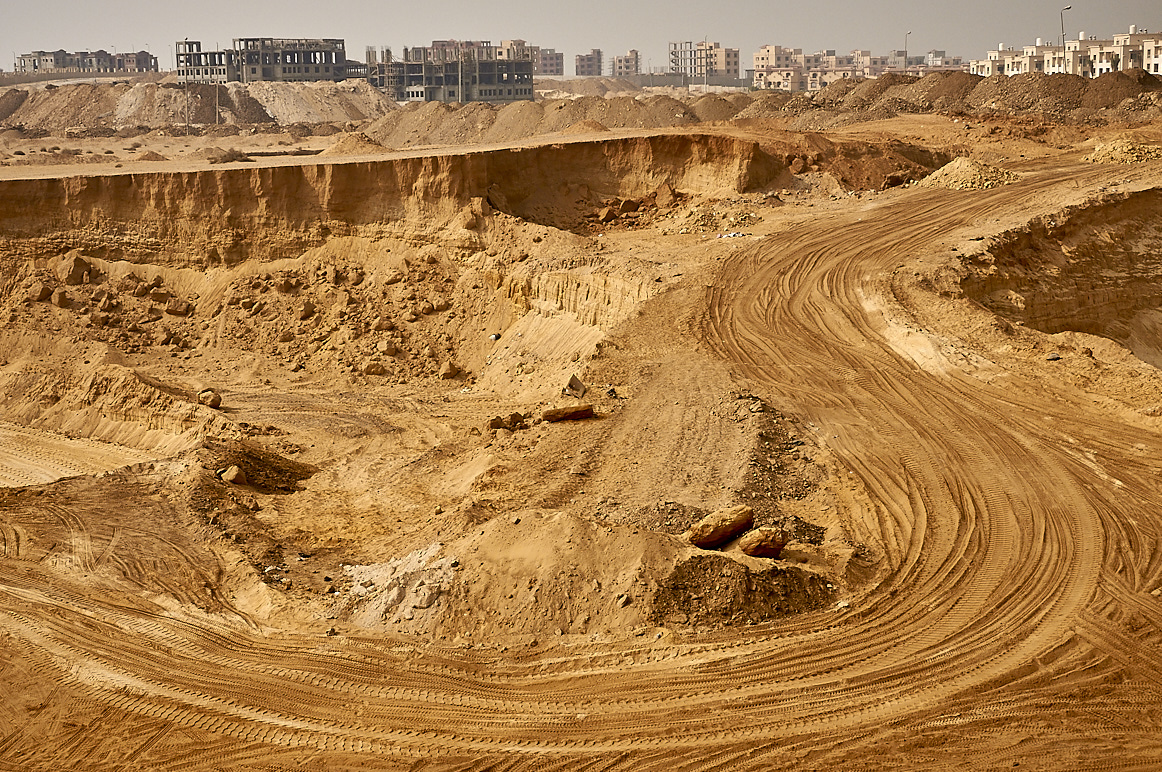
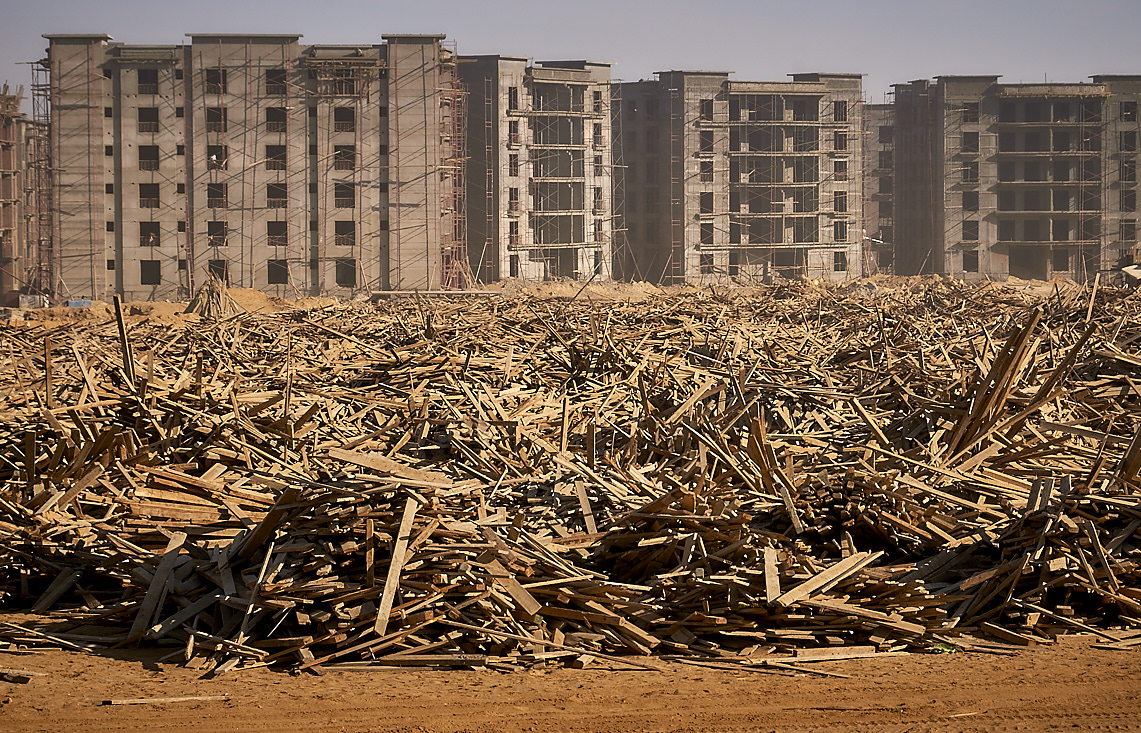
Wearing my Utah Jazz cap and sun-protection factor 50, with the camera charged with an 8 GB memory card, I want to escape from it all and go back to that wild, unhospitable landscape. There, the metropolis advances with the striking of shovels and the droning of cement mixers and power drills. In every city where I have lived, I have chosen to stay close to the periphery. In those areas, I openly admit that I escape from everything to the point where I flee even from myself, in order to witness the city in full transformation and assume the identity of an environment which is basically fragile.
My manner of approaching cities is to walk for hours from the outskirts inwards or vice-versa and at the end of the day, climb up to the top of a tower and assimilate the extent of the distance covered. I would often take a transatlantic flight just for the experience of arriving in a strange city and discovering the urban lay-out during 24 hours (under the effects of jet-lag) and return home. I have walked all the way from an airport to a city centre more than once in order to gain first-hand knowledge of a place.
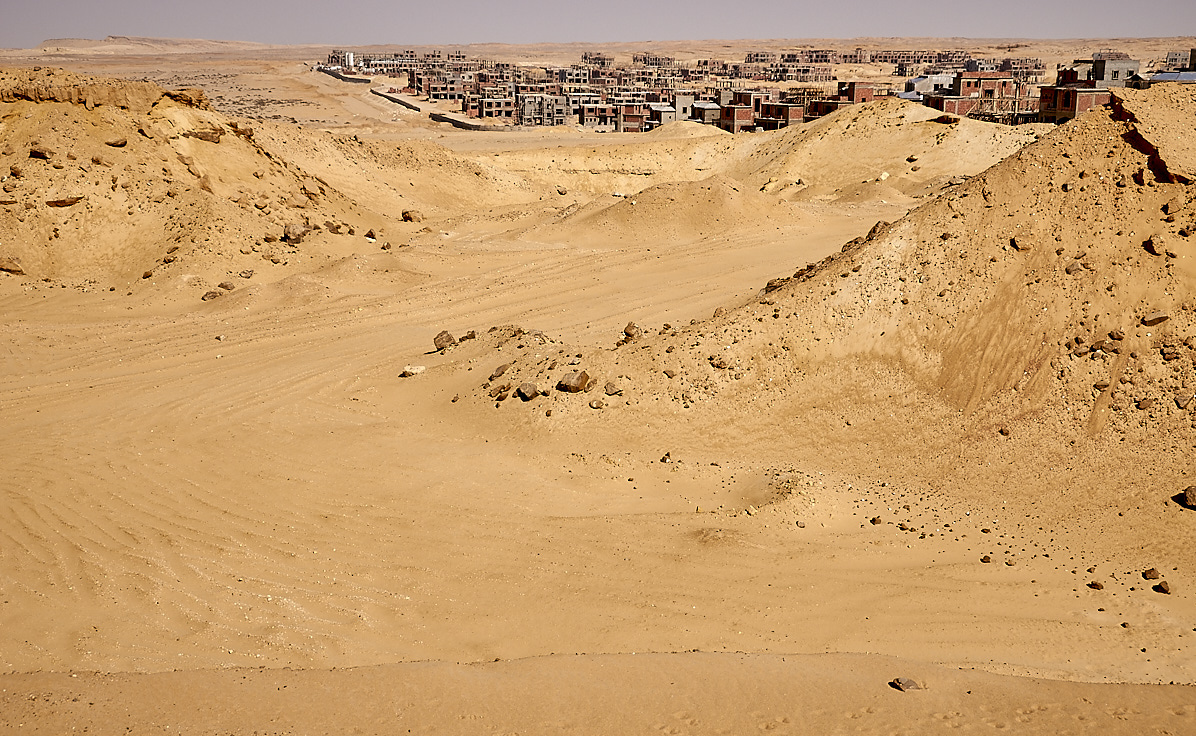
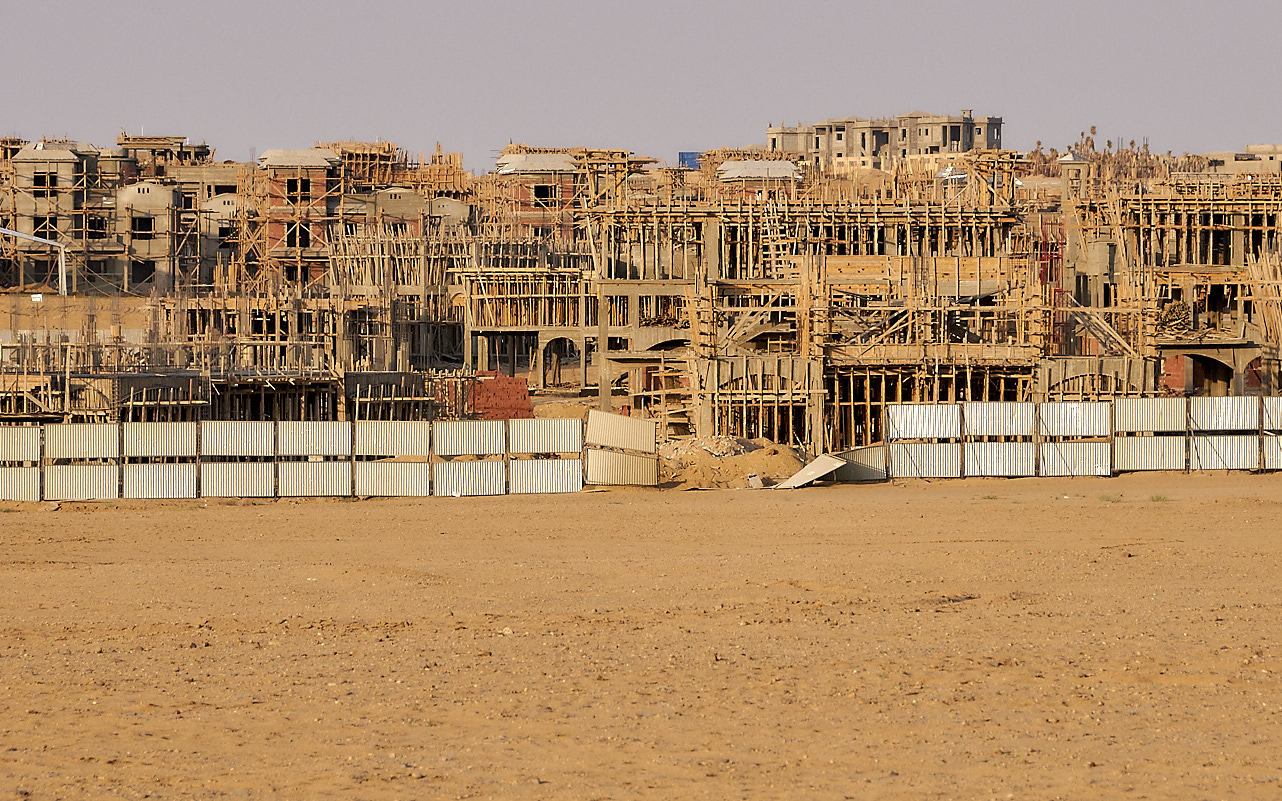
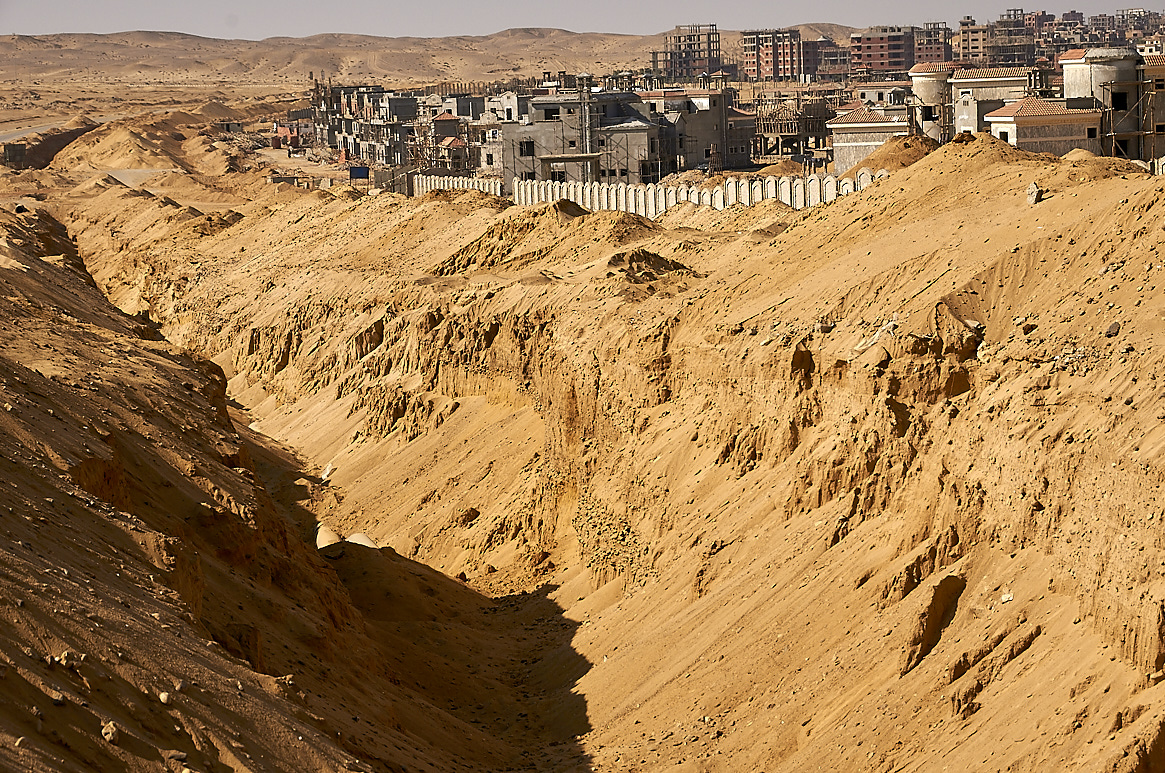
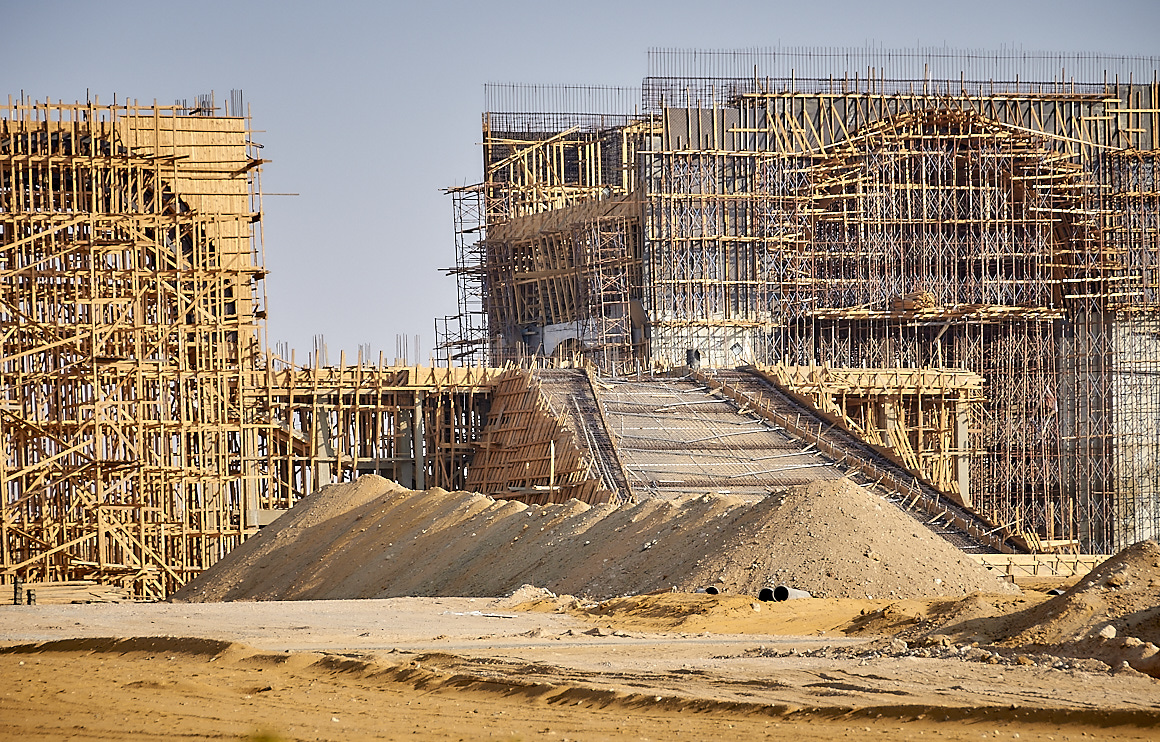
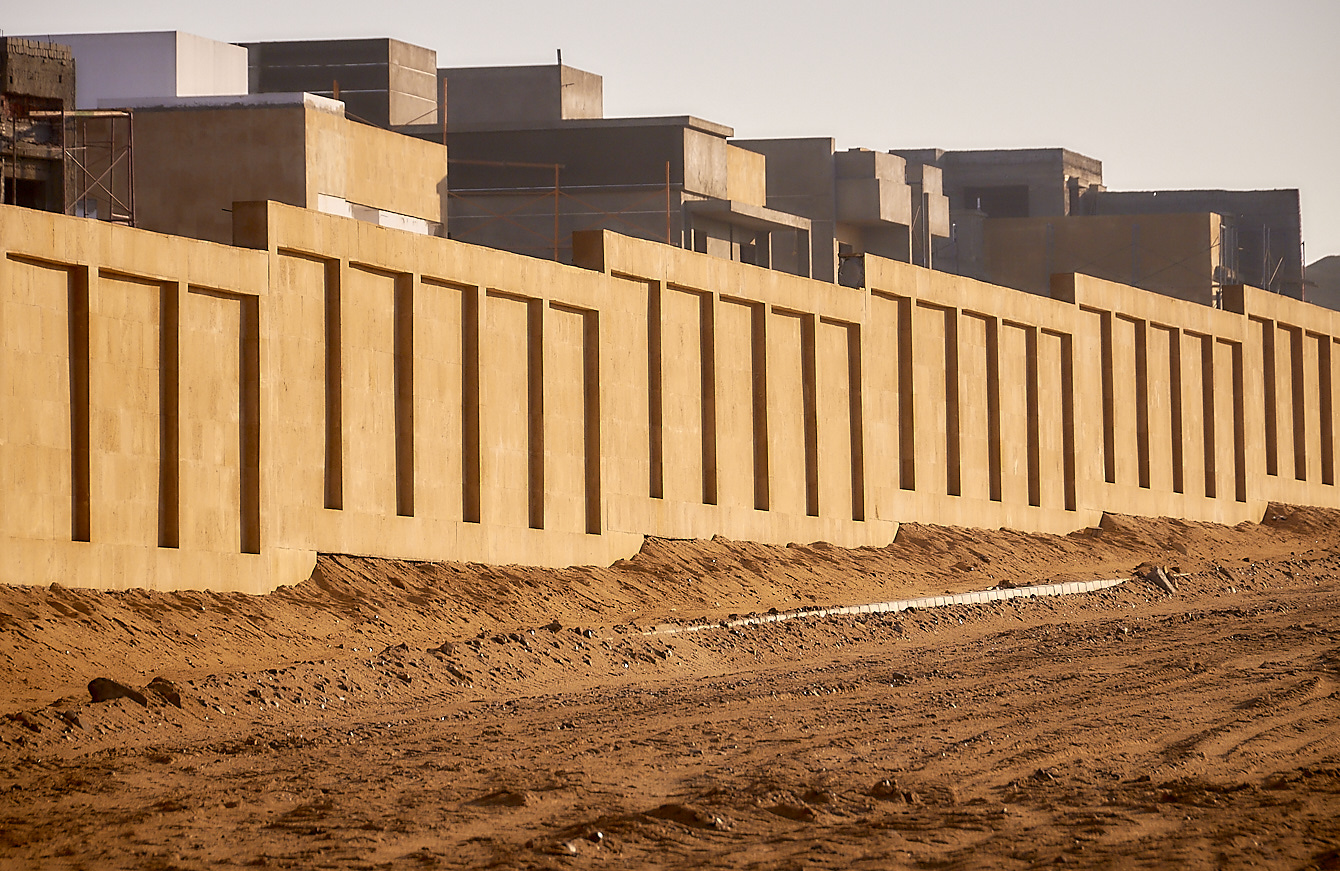
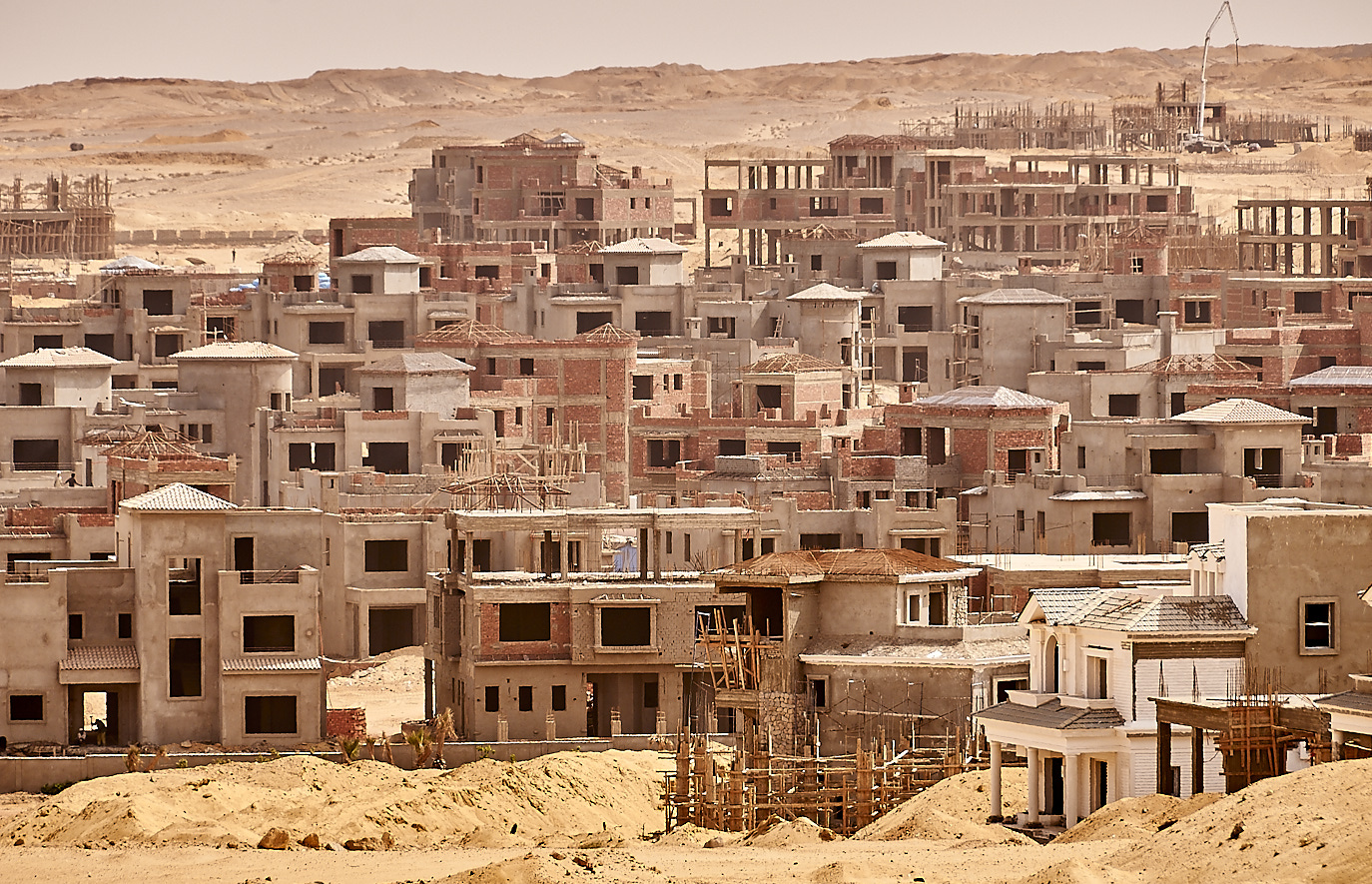
I have already gone round to the other side of the mountain of earth and am now not far from the great lake where massified villa construction is everywhere. The entrails of the new city are in full view with its pipes and cables at the base of the deepest gorges which will soon be covered over with pavements, garden turf and urban furniture. Wooden scaffolding covers the bare structures of the gated communities, placed in rows and seeming to sprout up like plants which grow on arid terrain.
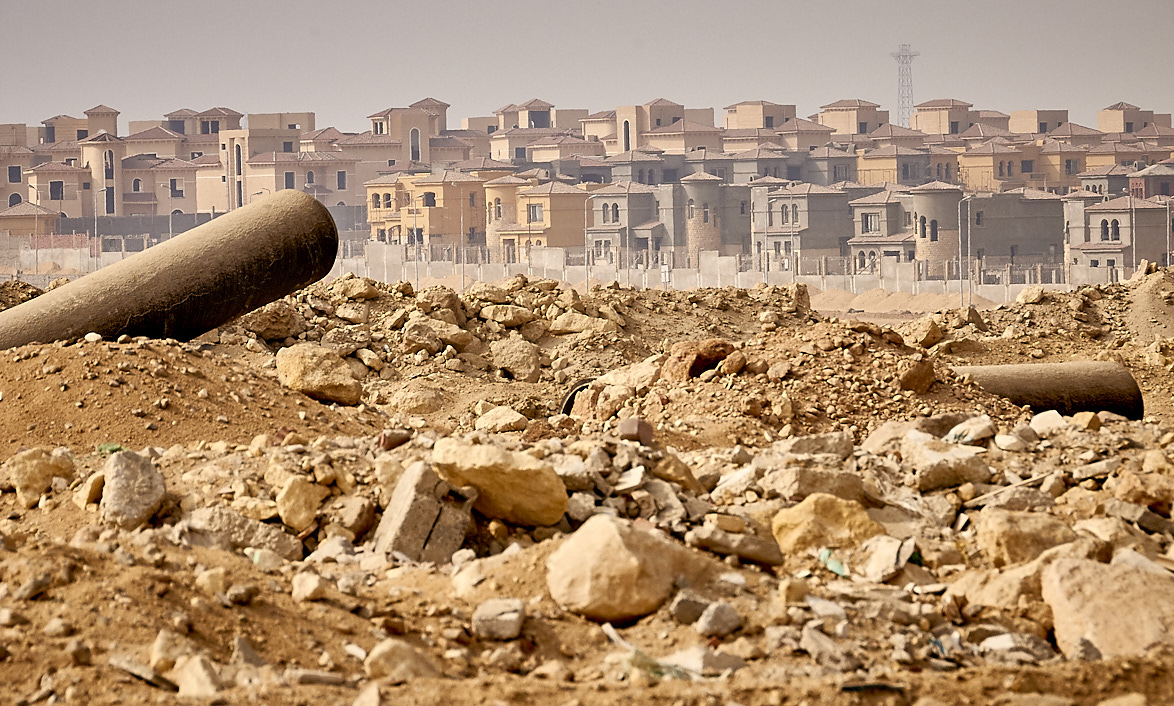
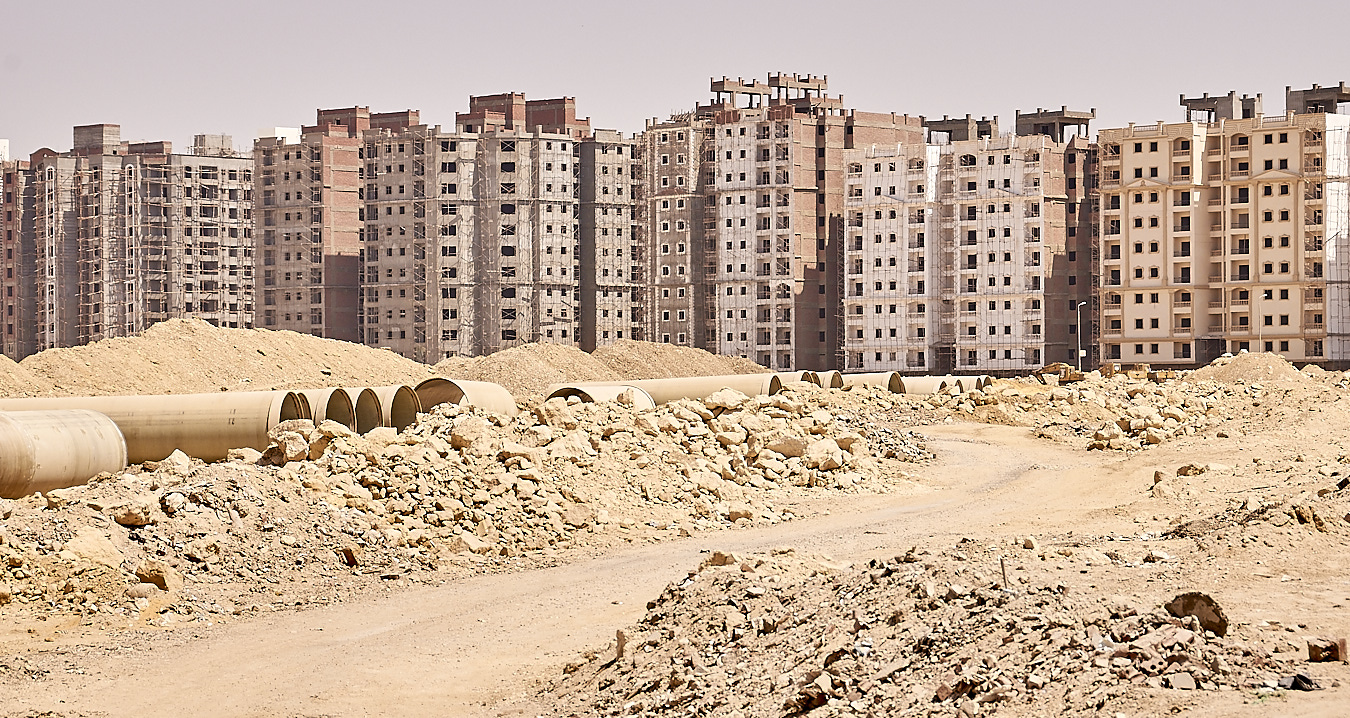
Immense concrete pipes leaning against mounds of earth are positioned like cannons, pointing towards luxury villas located behind thick rampart-like walls. This setting, which could have been arranged by a metteur en scène, is evocative of a medieval battle in the desert where hundreds of kilometres of land are seized, in the greatest urban development I can remember. Similar scenarios apply to Dubai with the creation of the marinas, or the colossal new town development in Chongquing, which I witnessed last year taking pictures from the rooftops, or the new commercial centre in Guangzhou on the Pearl River. Cairo is also following the global flow and as the new satellite city expands, it will be branded with a new identity.
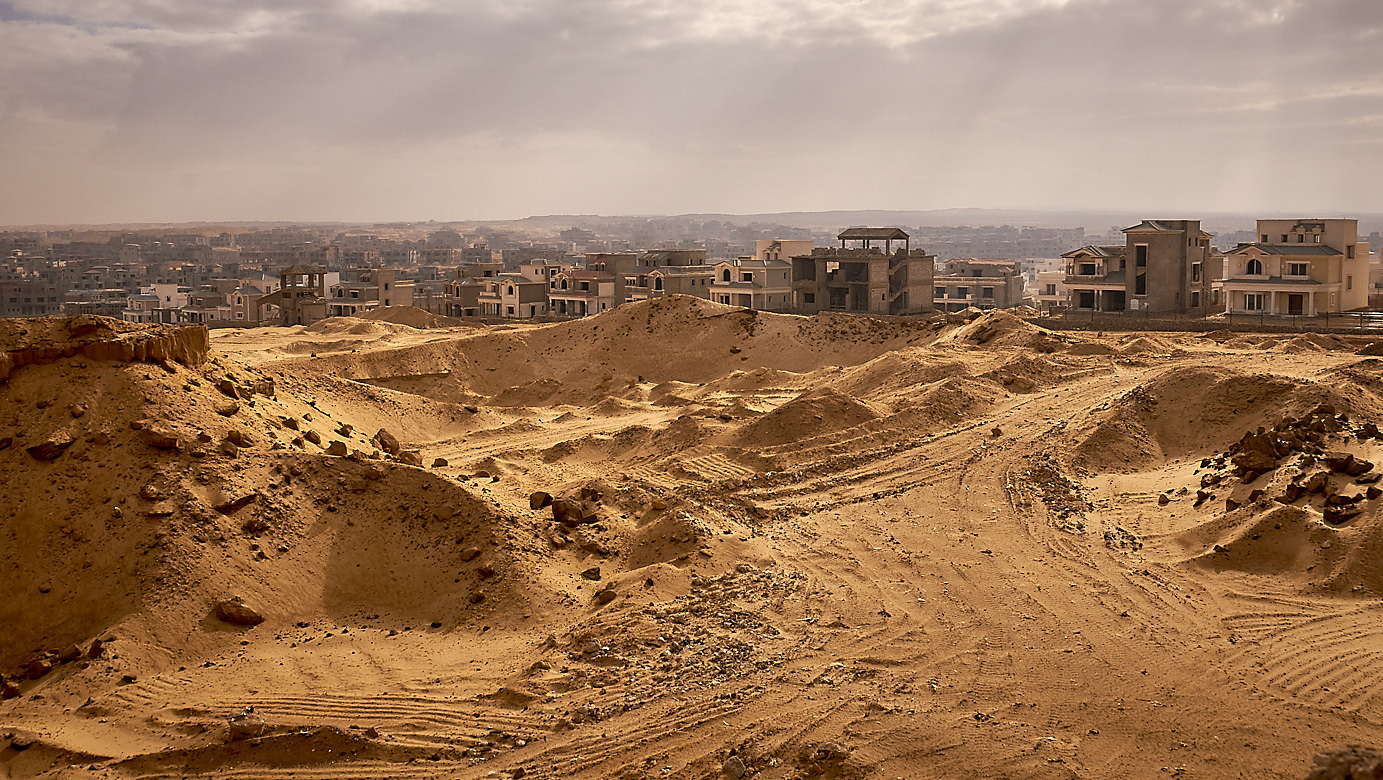
In the climate of a global slump in the real estate sector, Cairo, in common with other cities in the vicinity, such as Beirut, Tripoli and Libya, is experiencing a phenomenal construction boom. What differentiates New Cairo is the sheer magnitude of the surface area, primarily with scattered, horizontal building projects with the exception of some solitary skyscrapers and developments of a certain density like El Rehab and others en-route to Suez. On the other hand, Beirut’s skyscrapers are very spread out in the new downtown area. Tripoli also supports the idea of building very large structures in its five-star district next to the Old Medina. Cairo, in contrast with the rest of Mediterranean cities, has practically no boundary to its growth. The desert absorbs everything like a sponge and there is always room for more.
In any case, it seems a pity, considering that Cairo has been a vertical city since time immemorial, demonstrated by the colossal height of the pyramids, thousands of minarets and the Zamalek skyscrapers from the ‘seventies, ‘eighties and ‘nineties. The decision to spread horizontally with a proliferation of gated communities will approximate Cairo to similar case scenarios such as Manila or Johannesburg. Once again, the desert is the way forward for many people, and things which are difficult to understand will eventually become part of the city’s history.
Whatever sociologists or urban architects might say, in my opinion, the sensation I wish to transmit to the public through images is very likely to provide unprecedented visual pleasure. With my photographic work, I document cities in order to suggest that they probably evolve in much the same way as people, with the passing of time. What we are witnessing now on the outskirts of Cairo will no longer be visible in a few decades from now, as if whisked away by a sandstorm.
Dear Mark, it’s time for me to take my leave. As I climb up a dune behind a mound of rubble, it’s already impossible to glimpse any trace of civilisation. The sun is setting and I am surrounded by absolute silence. I rest on a rock and while my tranquility is interrupted by the barking of building-site guard dogs, I wonder, “Where do I come from? How did I get here? What will happen, after Cairo? What does the future hold for Cairo, Mother of all Cities?”
«Letter From Cairo» (Mark Magazine)